Re-listening to interviews I recorded three years ago, with AI doing the synthesis pass
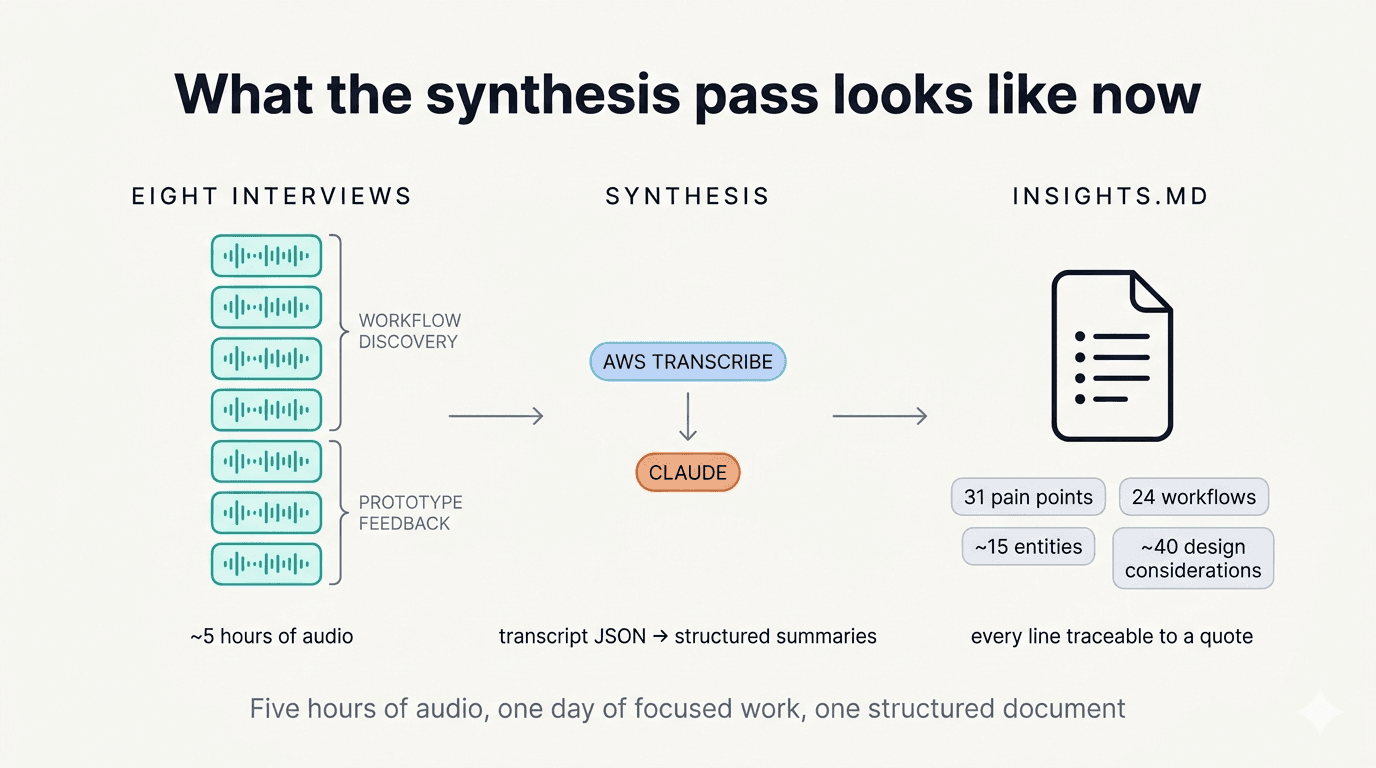
I'm re-listening to eight voice interviews I recorded with a friend three years ago.
Five of them were a full walkthrough of how she runs her therapy practice: how her day goes, how her Google Sheet works, where the paper notes fit in, how she handles WhatsApp messages from patients, and how her invoicing process works. Three were prototype feedback on early sketches I'd put together. Roughly five hours of audio total.
Back then I did what felt like the only thing to do. I listened to each recording, took notes in my notebook, tried to keep the threads straight in my head, and started drawing screens.
This time I'm doing something different.
The original attempt
In 2023 the "synthesis pipeline" was me, the recordings, my notebook, and a pen.
Transcription tools existed. I just didn't seriously consider running them. The audio had two voices that overlapped, the cost per minute on the few options I looked at was real, and there was no obvious place to put a transcript even if I had one. So I did it by ear. I'd listen for ten minutes, pause, scribble something in the notebook, rewind because I'd missed a phrase, scribble more.
The output of that process was a stack of notebook pages and a vague mental model. Some of the pain points made it onto paper. Most of them stayed in my head and slowly leaked out as the weeks went on. The synthesis happened in my brain, and my brain was also busy with client work and dishes and everything else. There was no structured artifact at the end of it. There was just me, trying to remember what she'd said the first time I listened.
That's most of why the project paused. I didn't have the hours to build anything. But I also didn't have a structured thing to build from. The interviews were five hours of audio sitting on a hard drive.
The restart
When I picked the project back up earlier this year, the first decision I made was about that audio.
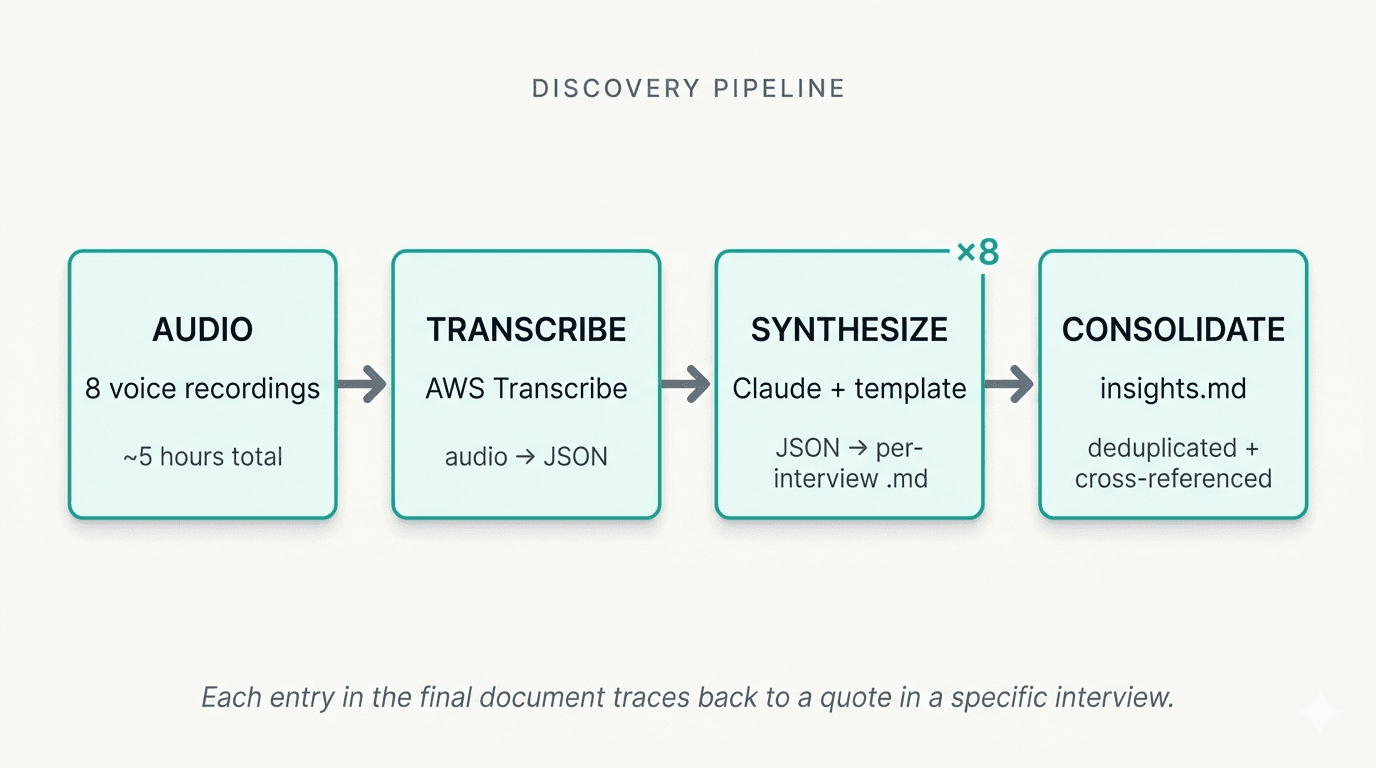
I ran every recording through AWS Transcribe. JSON came back for each file: timestamped segments, speaker labels, alternative phrasings for the parts where the audio was muddy. The transcripts were good. Not perfect, but good enough that I could read them and reconstruct the conversation in my head without re-listening.
Then I handed the JSON to Claude. I wrote a template for a per-interview summary: a detailed breakdown by topic, entities identified, pain points listed, workflows extracted, design considerations flagged. I gave Claude one transcript and the template and asked for the summary. I read what came back, edited the parts that were thin or wrong, and moved on to the next one.
Eight interviews, eight markdown files. About a day of focused work.
The output
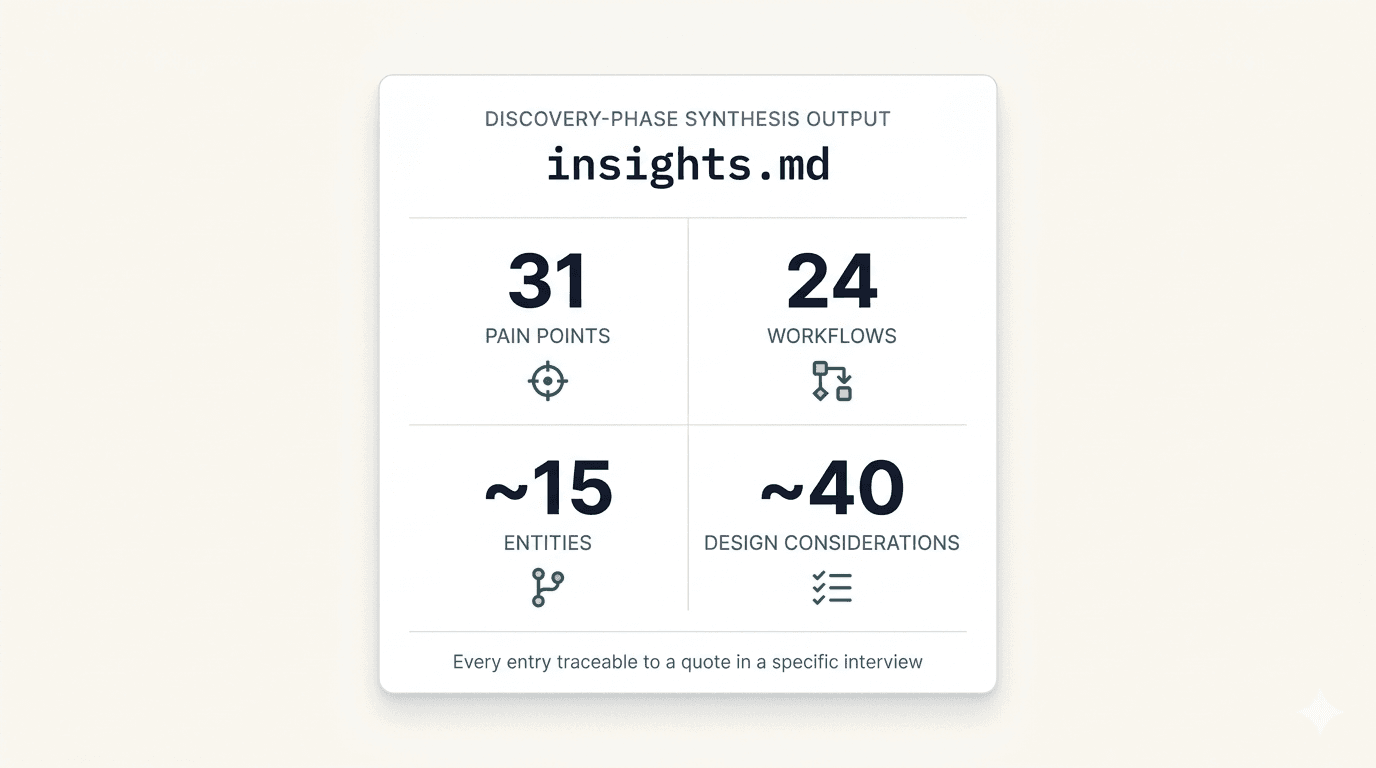
What came out of those eight files was a single consolidated document I now call insights.md. It collects everything across the eight interviews, deduplicated and cross-referenced.
The phase baseline:
31 pain points
24 workflows
~15 entities
~40 design considerations
Each entry has a source column linking it back to the specific interview it came from, and inside each interview summary the entries link back to the exact moment in the conversation. Every line in the document traces to something the friend actually said. The document is the foundation I now build specs on top of. When a new question comes up months later, I don't go back to the audio. I go back to insights.md.
That artifact is the thing that didn't exist in 2023, and the thing that's making everything downstream possible.
What I notice as I do this
Two things have been on my mind since the synthesis pass landed.
The first one is obvious in retrospect. The slow part of discovery, for me, was never the listening. It was the synthesis. Listening is one pass through five hours of audio. Synthesis is the work of pulling structure out of unstructured input: noticing what was said twice but in different words, noticing what wasn't said but was implied by a long pause, noticing which workflows depended on which entities. By hand that work took me weeks and I never finished it. AI did it in an afternoon and produced an artifact I can hand to a future me, and have it still make sense six months later.
The second one is what changed about my mental model. I came into this expecting AI to help me write code. It will. The code phase is going to take days instead of months. That part was always going to happen. What I wasn't expecting is what happened to discovery. AI didn't just help me code faster. It changed the shape of discovery itself. The hours I was bracing to spend re-listening and re-noting, I didn't have to spend. The structured artifact I never made by hand, I now have. The phase I'd always thought of as a warm-up for the real work is now where some of the real work happens.
This pace runs heavy, I'll say it plainly. The project has five years of historical data and no commercial deadline. I had room to throw a careful pipeline at it. For a normal MVP, the same pipeline compresses to a couple of weeks. The shape is portable. The budget moves with the scope.
I'm not making a universal claim about AI and discovery. I'm just saying the bottleneck I had three years ago wasn't where I thought it was. I thought it was my coding hours. It turns out a lot of it was the synthesis pass I never finished. AI took the synthesis pass off my plate, and the project moved.
#BuildInPublic #ClaudeCode #AIEngineering #AIAgenticEngineer