
How to choose the group you launch to
If your product could plausibly serve a dozen different kinds of people, you have a harder marketing problem than a product that serves one. Breadth reads as an asset while you are building. It turns into a liability the first time you have to write a sentence about who the product is for, because a message addressed to everyone is heard by no one.
The symptom is specific. You write down the candidate groups, every one of them sounds arguable both ways, and the arguing never resolves because nothing in it touches evidence. So you pick the one that feels right, in about ten minutes, and that ten minutes quietly governs your landing page, your pricing, your store listing, and your first hundred users.
This is a process for making that choice on purpose. It takes a few weeks of part-time work, most of it cheap, and it is built so the decision at the end can be shown wrong later.
What it produces
Three things:
A list of candidate groups, each scored against a fixed rubric, with an evidence citation behind every score.
Three assigned roles: one group you launch through, one you grow into, and one cheap experiment on an outsider.
A decision recorded at a named point, in a form specific enough that a later signal can contradict it.
What it does not produce is a correct answer. It produces a defensible one, with its reasoning attached, which is a different and more useful thing.
Why one group, and not all of them
Geoffrey Moore's Crossing the Chasm is the classic statement: you do not enter a broad market broadly. You enter through one group narrow enough that you can own its conversation, win it completely, and expand from there. Maja Voje's The Go-to-Market Strategist is the operational version, and it is what the steps below are built on.
The distinction that makes this bearable: a beachhead narrows the marketing, not the product. You are not building a smaller thing. You are picking one group, learning their language, setting the product up so it is useful to them on the first day, and speaking only to them for a while. Each group gets a different setup, never a different product. If serving a group would require forking what you built, that group is not a beachhead, it is a second company.
Step 1. Build the long-list
Write down every group your product could plausibly serve. Expect more than you want.
Then filter for what counts as a group worth targeting. Three properties:
A shared place. Somewhere named and findable where they already gather.
A shared ritual. A repeated moment when they would use the product, not a hypothetical occasion.
A shared vocabulary. Their own words for the problem, which are usually not your words for it.
"People who care about productivity" has none of these. It is a demographic. A group is narrower than feels comfortable, and if a candidate row cannot name a place and a ritual, it is not ready to be scored.
Two rules for the list. Keep it open: your instruments will surface groups you did not think of, and those rows join the list and get scored like the rest. And include a control row, a deliberately unglamorous version of your most obvious user. It is not a candidate. It is the null hypothesis every real group has to out-score, and it will kill more enthusiasm than any other row.
Step 2. Write the scoring rules before you collect any evidence
This is the step people skip, and it is the one that makes the rest honest.
You already know which group you want to win. That is the normal condition of anyone who has been building something for months, and it is exactly why the rules cannot be written afterwards. Score once the evidence is in front of you and you will score it to fit the answer you already like, and it will feel like careful judgment the entire time.
So the rubric gets written first, and one rule inside it does most of the work:
> No evidence citation, no score.
A score with nothing behind it is a guess. Mark it as a guess, in the cell, and let it read as one in the final table. On a first pass, most of them are.
Then pre-register the expectation. Write down which groups you expect to win, date it, and put it somewhere you cannot quietly edit. This one comes from research practice rather than marketing, and it is the highest-leverage borrowing in the process. The prior exists to be falsified, not obeyed. If every guess survives contact with the evidence, get suspicious of the instruments rather than pleased with yourself.
Step 3. Score on seven tests
Each group gets 1 to 3 on each test, with a citation in the cell.
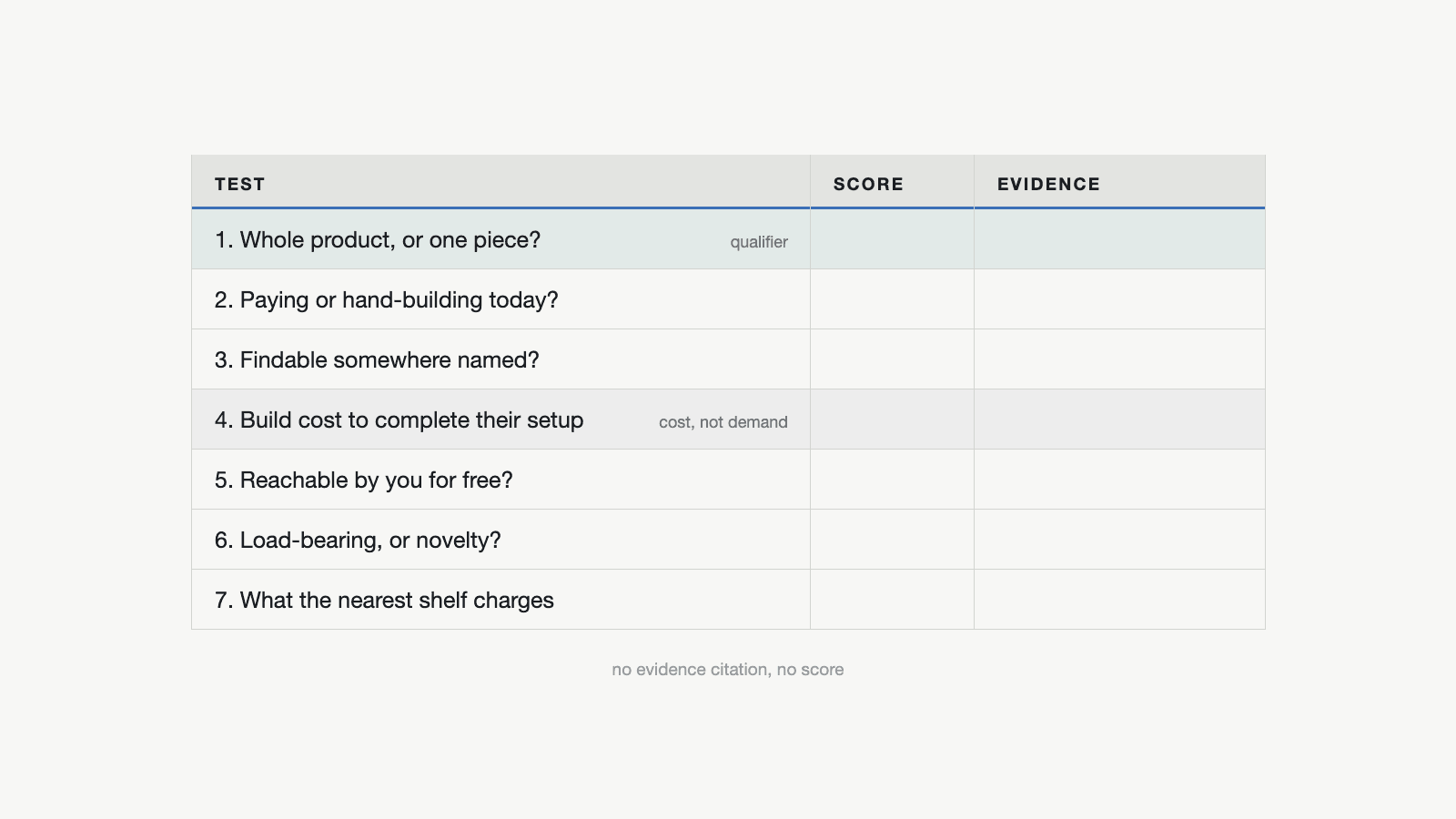
Whole product, or one piece? Do they need what you built, or does one small feature already solve their problem? This is the qualifying test. A group that scores lowest here is out regardless of the rest, because you would be selling a whole product against a free simpler one.
Are they paying or hand-building today? Money already moving, or serious effort already spent, is the strongest demand signal available before you ship. A group that neither pays nor hacks something together is not a market yet.
Can you find them somewhere named? A specific place where the problem is visible and discussed. If the only way to reach them is buying ads, a solo builder cannot afford the discovery loop, let alone the launch.
How much new work to complete their setup? How much you must build before the product is genuinely useful to them on day one, including any new integration class you do not already support.
Can you reach them credibly for nothing? Whether your existing presence and voice land natively in that place. Not whether you could learn to. Whether you already do.
Load-bearing, or novelty? Whether the product joins a routine that repeats year-round, ideally one shared with other people. Novelty churns in month three, and seasonality caps this score no matter how enthusiastic the group looks.
What does the nearest shelf charge? The price norms of whatever they already buy for this job. You inherit the ceiling of the category people file you under, which makes this a positioning fact as much as a pricing one.
The weighting matters more than the scores. Tests 2, 6, and 7 carry the subscription economics. Tests 3 and 5 carry the solo-builder reality, and they are the ones a funded team could ignore and you cannot. Test 1 is a pure qualifier, not a weighted input. Test 4 is a cost modifier: a bad score there means an expensive door, not a weak market, so it must never be averaged in as demand.
One habit worth building: read each test across groups, not only within one. If paid demand keeps clustering on one narrow capability rather than the whole product, that is a finding about your product's shape, and it matters more than which group ranks first.
Step 4. Pick instruments that can contradict you
Four, all cheap, run in parallel:
A store-search demand map. Harvest search autocomplete for your seed terms, across the stores and languages your buyers use. The useful output is usually negative: a phrase you were sure people typed, that nobody types.
Community and review mining. Find where each group gathers, then read the reviews of what they already buy. Five-star reviews tell you the job, one-star reviews tell you the gap. The cheapest instrument, and reliably the highest yield.
An in-product fake door. Offer the thing you have not built, count who asks for it, and include a free-text box so people can name the thing you did not think to offer.
A small paid smoke test. One landing page per angle, a fixed budget, cost per signup as the readout. Set the budget in advance and set it low enough that a null result is affordable.
The rule that governs all four: each instrument must be able to return a number you do not like. One that can only confirm you is decoration, and building decoration costs more than skipping the step.
Step 5. Assign three roles, not one
One group cannot carry every job, so stop asking one choice to do it.
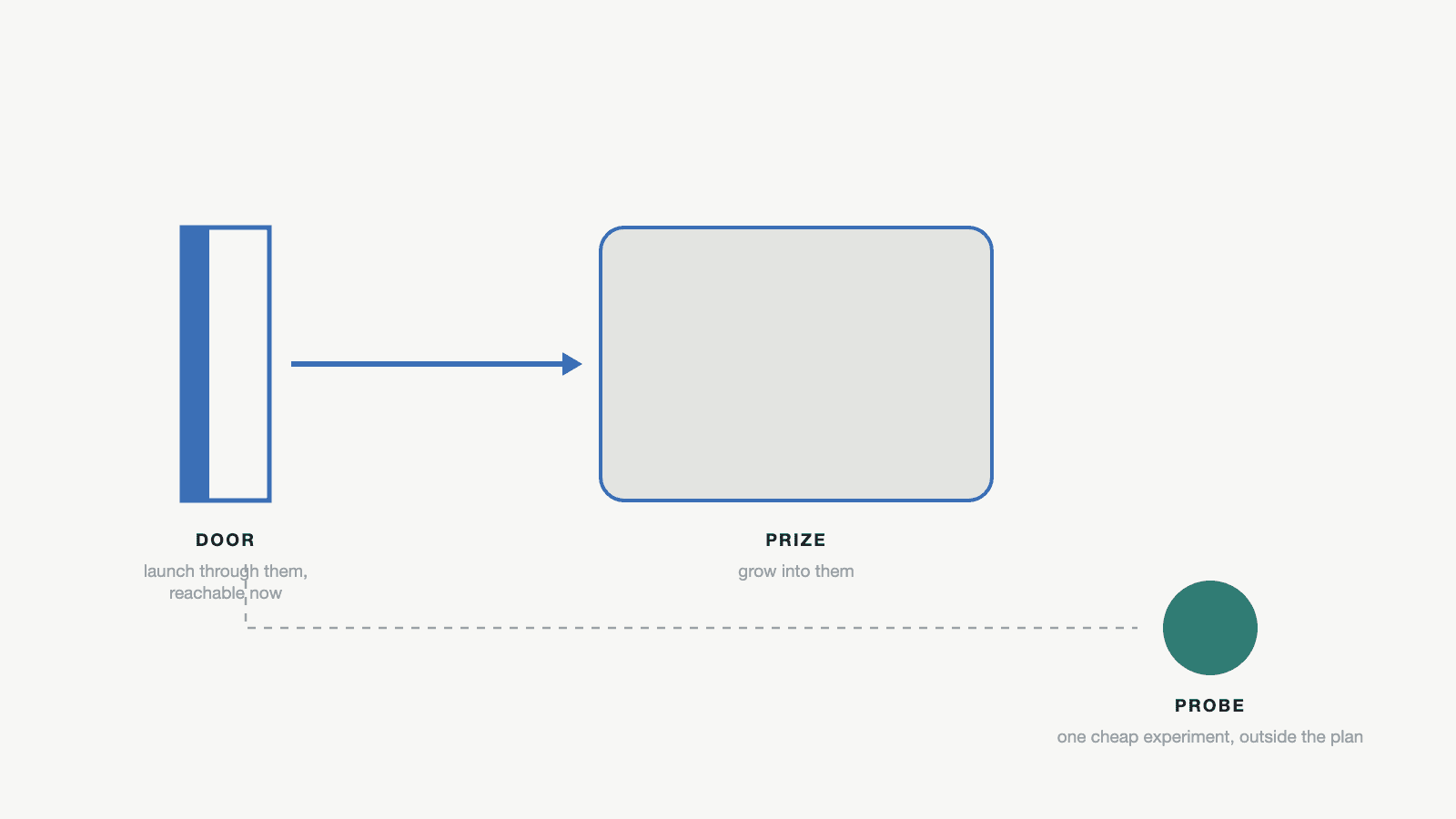
The door is the group you launch through. It must be reachable by you, now, with no budget, and the product must be close to complete for them already. Nothing about the door is aspirational.
The prize is the group you want to grow into. Larger, harder to reach, or more expensive to serve. Not where you start, but if the door does not eventually open onto it, you picked the wrong door.
The probe is one cheap experiment on an outsider. A group nobody would list as the obvious answer, that might pay more than expected. It exists because your sense of the obvious answer is the least reliable input you have, and buying the information is cheaper than keeping the opinion.
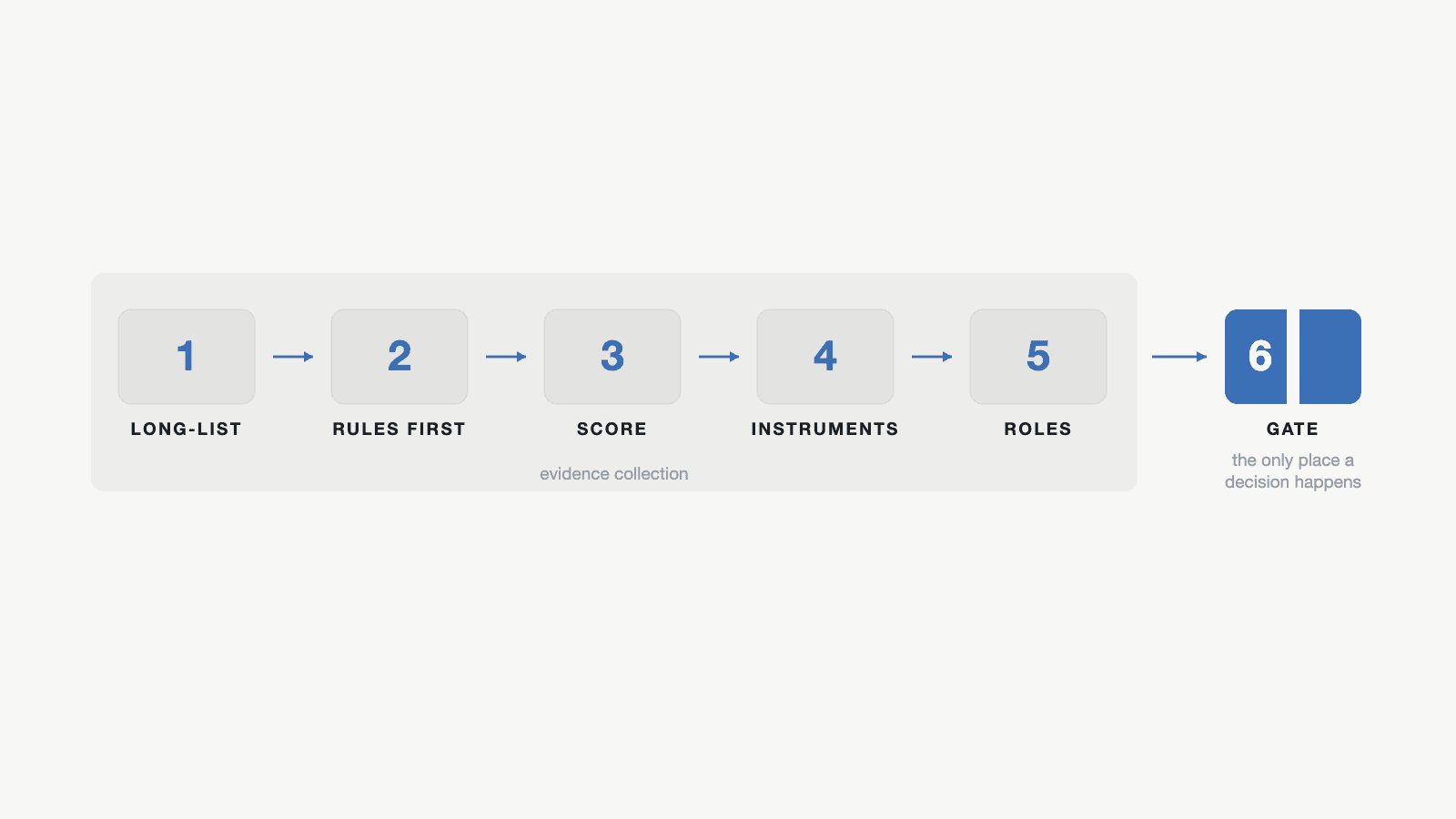
Step 6. Put the decision at a named gate
Decide in one place, on purpose, and nowhere else.
Everything before the gate is evidence collection, and no quantity of it is allowed to turn into a decision early. This sounds bureaucratic until you notice how often a promising signal at week two has silently become the answer by week four.
The gate does not close until one sentence has no blanks left in it:
> We launch to [group] with [the two or three things that complete their setup], we reach them via [channel with a measured cost or organic traction], they pay because [evidence], and they are still using it in month three because [structural reason].
Every blank you cannot fill is research you have not done. That is the sentence's purpose: it converts a vague sense of readiness into a specific list of what is missing.
Where the process bends
A tie. Break it on tests 3 and 5, reachability and channel fit, never on which market is bigger. Size is the prize's problem, not the door's.
High scores, thin evidence. A group whose scores are mostly guesses ranks below a group with lower scores and real citations. That is the rule working, not the rule failing.
An instrument contradicts a test you already scored. Rescore it, and leave the old score visible with the date. A rubric that only ever moves in your favor is not measuring anything.
The budget will not stretch. Cut the paid smoke test first, the only step that costs real money. Steps 1, 2, and the mining instrument cost nothing but hours and carry most of the value.
The evidence says your product is the wrong shape. This is the outcome worth designing for, and the reason to run the process before launch rather than after.
Bibliography and provenance
Where each piece came from, and how it was actually used. The last three rows are the ones usually left out, and they are the most informative.
| Element | Source | How it was used | | -- | -- | -- | | Entering a broad market through one narrow group | Crossing the Chasm, Geoffrey Moore | The classic statement of the idea. Used for the concept, not the sequencing | | Early-customer definition and the operational sequence | The Go-to-Market Strategist, Maja Voje | Used as written, the market and early-customer chapters. The spine of steps 1 and 5 | | A weighted, evidence-cited scoring matrix | Standard segment-selection practice, no single author | Assembled from practice, then customized. Three of the seven tests come from named sources, below | | Test 1, whole product versus one piece | Jobs-to-be-done | Adapted into the qualifying filter rather than used as an interview technique | | Test 6, load-bearing versus novelty | Hacking Growth, Sean Ellis and Morgan Brown | The must-have lens, adapted: asked as a structural question before launch instead of as a survey after it | | Test 7, category price ceiling | Obviously Awesome, April Dunford | Dunford's market-frame insight, that the category you are filed under sets what you can charge, converted into a scored test | | Conversations that ask about past behavior instead of pitching | The Mom Test, Rob Fitzpatrick | Question design used as written. Adapted on recruiting: the book assumes you can get scheduled calls, which a solo builder with no audience often cannot, so this process uses asynchronous written exchanges instead. That costs you tone and follow-up, and it is the weakest link in the process | | Review mining, five-star for the job, one-star for the gap | Positioning research practice | A scaled proxy for Dunford's advice to talk to your happy customers, used when you do not have enough customers to talk to | | Store-search demand mapping | App-store optimization industry practice | Not from any book here. Named as practice rather than dressed up with a citation it does not have | | Fake door, and the smoke test | Product experimentation and lean-startup demand testing, plus Hacking Growth's experiment discipline | Assembled from practice. Ellis's must-have survey is the natural follow-on once you have a cohort, not before | | Pre-registering the expectation before the evidence | Preregistration norm from research practice | Imported wholesale. The highest-leverage borrowing in the process, and it comes from science rather than marketing | | Positioning, once the group is chosen | Obviously Awesome, April Dunford | The ten-step process, used as written. Deliberately out of scope here; it is the step after this one | | Lead and hook copywriting | Great Leads, Michael Masterson | Deliberately not used yet. Which lead to write depends on how aware your prospects already are, and awareness is an output of this research. Reaching for it early means guessing at its input | | Account-based go-to-market | MOVE, Sangram Vajre and Bryan Brown | Considered and rejected. Account-based motion built for business-to-business sales organizations, the wrong shape for a solo builder on a consumer product. Worth revisiting only if a business-buyer probe outperforms expectations |
What this process does not do
It does not tell you the right answer. It produces a decision with its reasoning attached, and a record specific enough to be contradicted when a later signal says you were wrong.
It is also a choice, not a requirement. A product with one obvious audience needs none of this. The process earns its cost only when the candidates outnumber your ability to argue between them.
And every instrument here is a proxy. Search volume, reviews, votes, and signups are all traces people left while doing something else. None of them is a buyer, and the day you can talk to actual buyers instead, do that.
#BuildInPublic #GTM #ProductStrategy #IndieHacker